
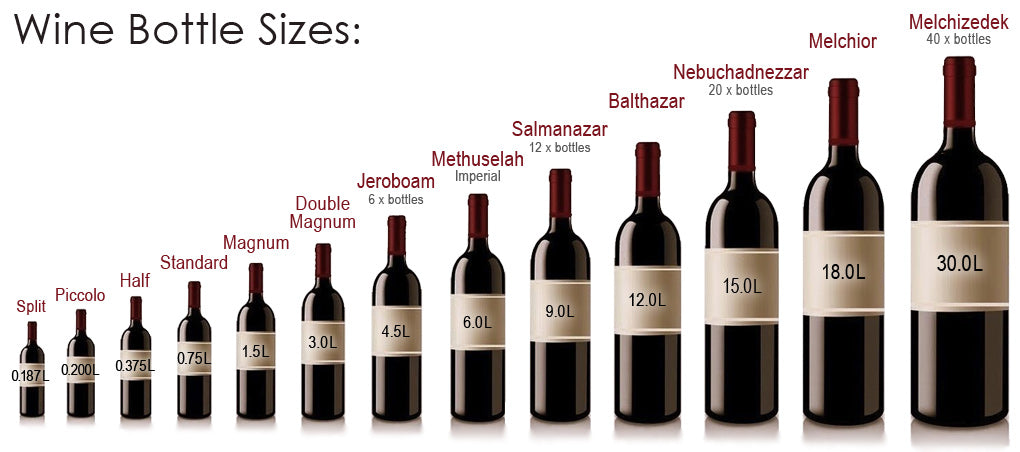
Split / Piccolo
187.5ml — ¼ bottle
The airline mini and picnic hero. Holds 187.5ml — a quarter of a standard bottle — and pours about one proper glass. Named piccolo, Italian for “small.” Perfect for a solo toast, a tasting flight pour, or a gift-bag treat.
🍷 Fun pour: 1 glass — one perfect pour, no leftovers, no sharing required.
Demi / Half Bottle
375ml — ½ bottle
Exactly half a standard bottle, pouring 2–3 glasses. The date-night specialist: enough for two generous glasses with dinner and zero temptation to open a full bottle on a Tuesday. Great for pricier wines you want to try without the commitment.
🍷 Fun pour: 2–3 glasses — the “just us” bottle.
Jennie / Half Litre
500ml — ⅔ bottle
The in-betweener that deserves more love. At 500ml it pours 3–4 glasses — ideal for one person over a long dinner or two people who pace themselves. Popular in parts of Europe for everyday table wine.
🍷 Fun pour: 3–4 glasses — the weeknight sweet spot.
Standard Bottle
750ml — 1 bottle
The one and only benchmark: 750ml, pouring 5–6 glasses. Every other size on this page is measured against it. Born of old glassmaking tradition, now the global default for still wine everywhere.
🍷 Fun pour: 5–6 glasses — the reliable classic.
Litre Bottle
1 litre — 1⅓ bottles
750ml’s slightly showier sibling. A full litre pours 7–8 glasses — that’s one bonus round for the table. Common in Germany and Austria, where a little extra Gemütlichkeit never hurt anyone.
🍷 Fun pour: 7–8 glasses — one extra round, on the house.
Magnum
1.5L — 2 bottles
Double the wine, double the drama. The Magnum pours 10–12 glasses and — here’s the nerdy bit — the same cork lets in the same whisper of oxygen as a standard bottle, so the wine ages more slowly and gracefully. The sommelier’s favorite format.
🍷 Fun pour: 10–12 glasses — the dinner-party hero.
Double Magnum / Jeroboam
3L — 4 bottles
Four bottles in one glorious vessel, pouring 20–24 glasses. In the world of still wine, “Jeroboam” and “Double Magnum” mean the same 3-litre bottle. Big enough to make an entrance, small enough that one strong person can still pour it.
🍷 Fun pour: 20–24 glasses — instant celebration.
Jeroboam — the Champagne Plot Twist
4.5L — 6 bottles (sparkling)
A Jeroboam is not always the same size. In the world of still wine, a Jeroboam is 3 litres exactly the same bottle as a Double Magnum. But in Champagne, it is 4.5 litres (what still wine folks would call a Rehoboam). So if someone offers you a Jeroboam, ask the follow up question: still or sparkling? Your pour 20 glasses or 36 depends on the answer.
🍷 Fun pour: 30–36 flutes — same name, supersized.
Rehoboam
4.5L — 6 bottles
The still-wine twin of the Champagne Jeroboam: 4.5 litres, six standard bottles, 30–36 glasses. Named for Rehoboam, the biblical king of Judah. Made for weddings, milestone birthdays, and any party where “one bottle” sounds like a joke.
🍷 Fun pour: 30–36 glasses — wedding-reception royalty.
Methuselah / Imperial
6L — 8 bottles
Eight bottles strong, pouring 40–48 glasses. In Champagne it’s called Methuselah; in Bordeaux, Imperial — same 6-litre giant. Named for the biblical Methuselah, famous for living 969 years, which feels about right for how long the toast will last.
🍷 Fun pour: 40–48 glasses — the grand entrance.
Salmanazar
9L — 12 bottles
A full case of wine in a single bottle: 9 litres pouring 60–72 glasses. Named for the Assyrian king Shalmaneser (Salmanazar in French), and traditionally grouped with the “wise men” names. The centerpiece your gala didn’t know it needed.
🍷 Fun pour: 60–72 glasses — a case of wine, one cork.
Balthazar
12L — 16 bottles
Sixteen bottles, 80–96 glasses, one unforgettable bottle. Balthazar — traditionally named as one of the Three Wise Men — is pure ceremony. Moving it requires planning; opening it requires an audience.
🍷 Fun pour: 80–96 glasses — gala-night legend status.
Nebuchadnezzar
15L — 20 bottles
Twenty bottles. One hundred to 120 glasses. Named for Nebuchadnezzar II, builder of the Hanging Gardens of Babylon — fitting, since serving from one of these is an engineering feat of its own. The undisputed heavyweight champion of the wine world.
🍷 Fun pour: 100–120 glasses — bring friends. And a sturdy table.
Melchior
18L — 24 bottles
Two full cases in glass: 18 litres pouring 120–144 glasses. Melchior — another of the traditional wise-men names — is so rare you’re more likely to see one in a museum than a restaurant. If you spot one, take a photo.
🍷 Fun pour: 120–144 glasses — 24 bottles deep, zero subtlety.
Solomon
20L — 26⅔ bottles
Twenty litres of prestige, pouring 133–160 glasses — the equivalent of more than two cases. Named for King Solomon, famed for his wisdom (and his very large banquets, presumably). Released mostly as limited Champagne showpieces.
🍷 Fun pour: 133–160 glasses — auction-house showpiece energy.
Sovereign
25L — 33⅓ bottles
Twenty-five litres — over 33 standard bottles — pouring 166–200 glasses. The name says it all. Reserved for the grandest receptions and collector auctions in Bordeaux and Burgundy.
🍷 Fun pour: 166–200 glasses — pure spectacle.
Primat / Goliath
27L — 36 bottles
Thirty-six bottles. Up to 216 glasses. Three full cases in a single bottle that stands about a metre tall. Called Primat — or Goliath, which honestly feels more accurate. A monumental toast, literally.
🍷 Fun pour: 180–216 glasses — needs its own zip code.
Melchizedek / Midas
30L — 40 bottles
The king of kings: 30 litres, 40 standard bottles, 200–240 glasses. Named for Melchizedek, the biblical king-priest of Genesis (Champagne houses often call their 30L release the Midas instead). It weighs as much as a person. Bow before it.
🍷 Fun pour: 200–240 glasses — the 40-bottle mic drop.
Send us your photos
Got a photo of a ridiculously large, rare, unusual, or downright wild wine bottle out in the world? We want to see it! Send us your best “wine bottle in the wild” photos and we may feature them on our site. The stranger, bigger, rarer or more unexpected, the better. Have a great one? Contact us and share it!